Mr Carnegie’s Ambition: On Becoming an Author
I’ve been doing some research on Andrew Carnegie for a potential new project. I’m from his Scottish hometown, Dunfermline, so I already knew his story in outline: the son of a poor weaver, who made his fortune in America through hard work (plus technological insight, opportunism, insider trading, and unspeakably horrible employment practices) and then gave most of it away.
Which is why Dunfermline has its own Carnegie Hall, plus a Carnegie Leisure Centre, a Carnegie Library, and the beautiful Pittencrieff Glen, which Carnegie bought and gave to the town as a public park because his own family was never allowed to go in.
I knew that Carnegie’s considerable ego wasn’t really invested in his business operations. He was famously keen on delegating the actual work to other people while he got on with the things he felt passionate about, such as philanthropy, travel, and advocating for world peace.
What I didn’t know was that, from very early on, he had one driving ambition that pre-dated the steel empire and the library programme and the valiant attempts to head off global war. He wanted to write books.
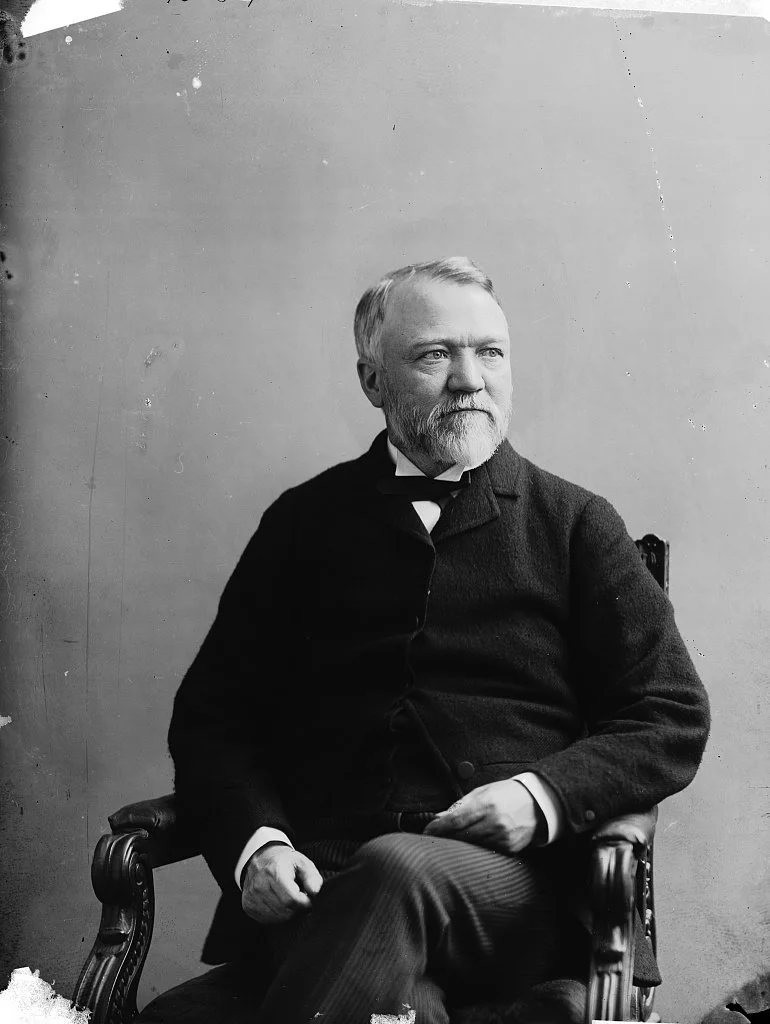
Andrew Carnegie: wee man, big ambitions. Photo from Library of Congress
Carnegie was a complex man, as David Nasaw’s excellent biography makes clear, and his contradictions can be challenging to understand from today’s perspective. Even his fellow robber-barons found him baffling. But in this one aspect, his motivations are pretty well timeless.
Andrew Carnegie didn’t get much schooling, but he loved books and was endlessly interested in stories and ideas. He enjoyed writing, and he wanted to communicate his thoughts to a wider audience. And no doubt he also wanted the respect and the validation that come with being a published author. As the son of poor Scottish immigrants, he had to build his own cultural capital.
Maybe that’s why writing was one kind of work that Carnegie wasn’t prepared to delegate. It was about who he was, and who he wanted to be.
Becoming an Author vs. Working as a Writer
Every writer has their own goals and motivations. But I’m guessing that Andrew Carnegie’s combination of passion, conviction and pride will be relatable to many of us.
His publication record is another matter. Carnegie’s first book, An American Four-in-Hand in Britain (1883), originated as a private account written to entertain the friends he took along on a coaching jaunt in 1881. By then he was already wealthy, and becoming famous, and he had no trouble finding a publisher – or an audience – for this or subsequent books. In modern publishing terms, he had a hell of a platform.
For the rest of us, setting out to build a writing career means balancing passion with practicality and ambition with survival. And that balancing act doesn’t stop once you get your first book deal. The majority of published authors do not make a full-time income from writing, nor do they build a steady career with a single publisher.
In these circumstances, it’s even more understandable that many people see publication as something aspirational, vocational, a form of self-actualisation. Not writing and selling a book, but becoming an author. After all, no sensible person would do it for the money.
I think that kind of wording is supremely unhelpful, and the best thing any writer can do is try to sever their self-worth from the books they produce. Resist the temptation to see published-author status as some mystical higher goal, and embrace writing for what it is: a specialised kind of work. Here’s why.
You already have a vocation
You’re a writer. If you put your own words on a page, you’re a writer. Congratulations! You’re in.
Yes, you need to sell something before you can call yourself a published author. But even if you have the ideal career, even if you publish book after book after bestselling book, there will always be that first-draft stage when it’s just you, your new story, and an uncertain future. So honour and protect your creative writer-self, and don’t hang your own value and that of your project on an external outcome. I promise, you’ll be happier and a whole lot less anxious. Not least because:
Rejections never stop coming
For all the precarious, uppy-downy nature of publishing, there’s something you can always rely on: your work will be rejected. It’s right up there with death and taxes.
Send your manuscript out to agents, and you’ll inevitably get some rejections. When you get an agent, and they send it out to publishers, at least some of those will reject it, too. When you get a publisher, they might reject your option book, or your idea for the next contracted one. Perhaps lackluster sales or a desire for change will propel you to start writing in a new genre, which might mean getting a new agent … and there you are, back in the query trenches, collecting rejections again.
This doesn’t say anything about the quality of your work. Agents and publishers operate on the big picture: what’s already on their list, what they think is likely to sell, what interacts best with their own strengths. You could write the most fantastic, compelling story known to humankind and it still wouldn’t be the right fit for everyone. It might not even be right for anyone at that precise moment – it might need to be reworked, or self-published, or put aside until its time comes around.
But that’s all right, since:
You are not your work
Rejections hurt. Even if you don’t take them personally – and it’s only natural if you do – there’s always the fear that you won’t find a home for your book. It’s a rational fear, too. Every career writer, no matter how successful, has books they’ve failed to place.
It’s especially painful for novelists, who usually need to write the entire manuscript before submitting to an agent or editor. Even if you’re established enough to submit a partial or proposal, your editor can still say no to the final product, or request a big rewrite. There’s no way to get around it: all those months of hard work, and worrying, and falling in love with your characters … might not pay off, or not in the way you hoped.
So you’ve got to go through the whole awful, wonderful process, just as I’m doing now with my Carnegie project. And then you’ve got to find a way to spare your sensitive heart when it comes to submitting the damn thing.
The standard advice, and the best, is to start a new book. Fall in love with your next story, and you’ll naturally become less invested in what happens to your previous one. But there’s an extra mental shift that can underpin this further.
Think of your book, not as your baby or the fruit of your creative process or the outpouring of your soul, but as something you have made. Being a writer isn’t so different to being a cabinet-maker or a master luthier or any other kind of craftsperson. It’s expert work and only you can do it in this specific way, but it is work, and when it’s done, you have a product.
Andrew Carnegie would approve, but then again, so would my miner and dockyard-worker ancestors. Keeping a separation between your self and your work is a crucial sanity-maintaining strategy in a brutal and changeable world.
What’s more, and this is the truly important thing, your book exists. You made it and it’s beautiful. By definition, its existence is justified.
And when it comes to sending it off to an agent or an editor, I strongly recommend adopting Emma Darwin’s paradigm: you are offering your work for that person to accept or decline. In fact, I recommend reading and absorbing her guide to dealing with rejection, because it’s a treasure.
Publication is Contingent. Craft is Forever.
That’s what it really boils down to. Getting published is hard enough, but staying published is a whole other matter. Unless you’re exceptionally fortunate, your career path is unlikely to be linear. Breakouts and flops, pivots and comebacks, even periods in the wilderness are all standard parts of a long-term author trajectory.
As long as you’re writing, you’re a writer. A working, hoping, loving, improving writer, with a brain that spits out stories whether the world wants them or not. All else, however important, is secondary.